
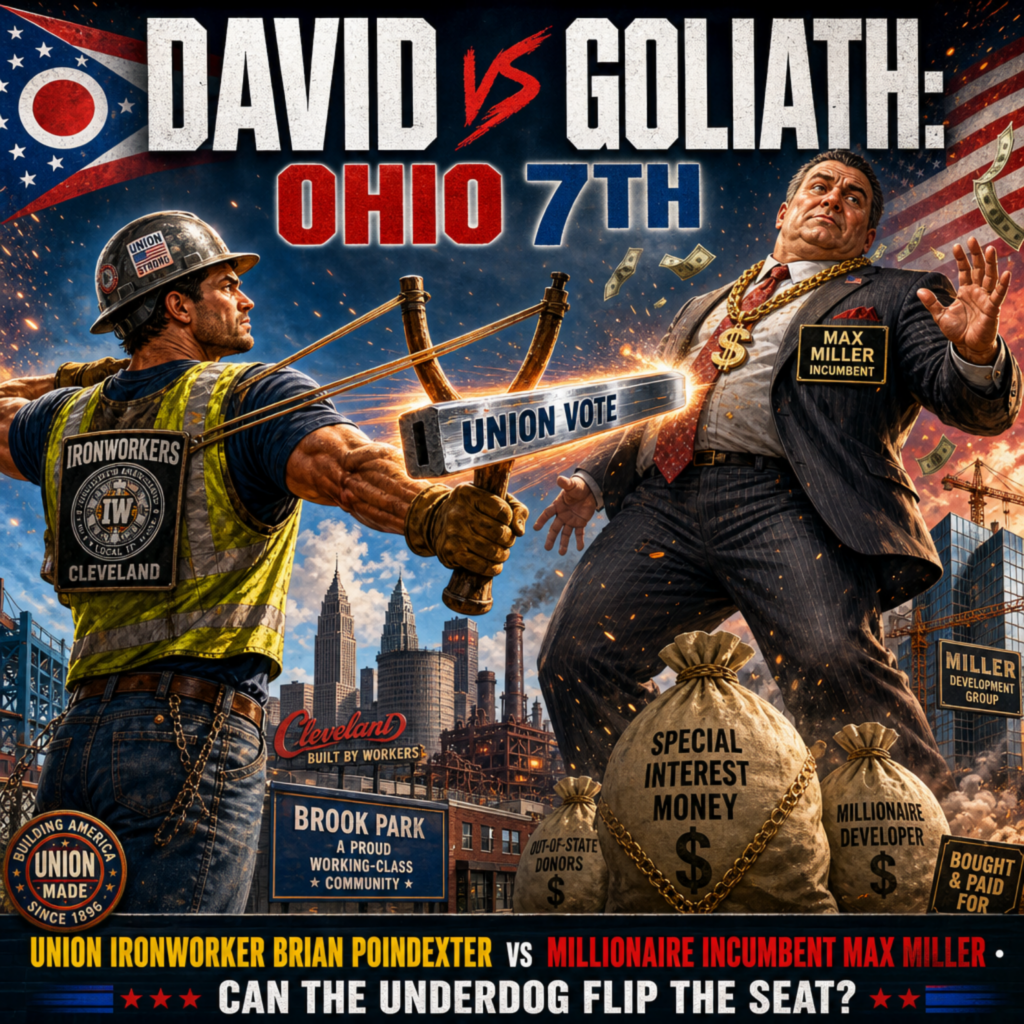
In the suburbs and exurbs west and south of Cleveland, a classic underdog story is unfolding. On one side stands Brian Poindexter, a lifelong union ironworker, Brook Park city councilman, and apprenticeship instructor with Ironworkers Local 17. On the other is incumbent Rep. Max Miller, heir to one of Cleveland’s wealthiest real estate dynasties and a firmly entrenched Republican in a Trump-friendly district.
This is shaping up as the ultimate working-class vs. wealth matchup in Ohio politics.
Roots That Couldn’t Be More Different
Poindexter’s story is straight out of the trades. He joined the ironworkers later than most, completed his apprenticeship, became a union organizer helping non-union workers gain representation, and now trains the next generation. He’s a father, a councilman who fought for local workers, and a candidate who proudly campaigns on “rewarding work, not wealth.” Labor groups from the Ironworkers to the Ohio AFL-CIO have lined up behind him.
Miller, by contrast, comes from deep Cleveland money. He is the grandson of the late Samuel H. Miller, longtime co-chair of Forest City Realty Trust — one of the region’s most powerful development empires. Miller’s personal and family wealth has been estimated in the millions, giving him a significant financial head start in politics.
The Money Gap: Goliath’s War Chest
As of mid-April 2026 campaign finance reports:
- Max Miller (R): Raised $1.73 million, spent $726k, with $1.18 million cash on hand.
- Brian Poindexter (D): Raised $217k, spent $126k, with $91k cash on hand.
The incumbent holds roughly an 8-to-1 fundraising advantage — classic Goliath territory. Yet Poindexter’s campaign is fueled heavily by small-dollar and labor donations, reflecting grassroots energy rather than big-donor checks.
Lessons from 2024: The Perils of a Split Vote
In 2024, Miller won re-election with just 51.1% in a three-way race. Democrat Matthew Diemer took 36.1%, while former Cleveland Mayor and Congressman Dennis Kucinich ran as an independent and siphoned off 12.8% (over 51,000 votes). That split helped Miller survive with a narrower margin than many expected in an R+5 to R+11 district.
This time, Democrats have consolidated early behind Poindexter, who won a crowded primary with 37% in a field of eight. No major independent spoiler has emerged yet (though one remains on the ballot with zero fundraising). If Democrats unify, the path to narrowing or flipping the seat becomes far more realistic.
Shifting Winds?
President Trump’s second-term approval ratings have turned underwater in recent polling, with national disapproval often in the high 50s to low 60s and net negatives in the double digits. Ohio-specific surveys have shown similar softness. In a midterm environment where the president’s party historically struggles, even a solidly Republican district can feel the breeze of change — especially when the challenger offers a compelling local, working-class contrast.
Cook Political Report and other forecasters still rate OH-07 as Solid Republican, but history shows that incumbents with personal wealth can sometimes struggle to connect with voters squeezed by costs. Poindexter’s backers argue that a disciplined, high-turnout campaign rooted in unions, infrastructure jobs, and pocketbook issues could produce the upset of the cycle.
David has entered the arena. The sling is loaded. Whether the stone finds its mark in November remains to be seen — but in a year when voters seem restless, this Brook Park ironworker is betting that working-class roots can overcome inherited millions.
The Cleveland Leader will continue tracking this race closely and plans an endorsement in early October.