

Let’s start with the elephant in the room — or more precisely, the elephant that the Rock Hall pretended wasn’t in the room.
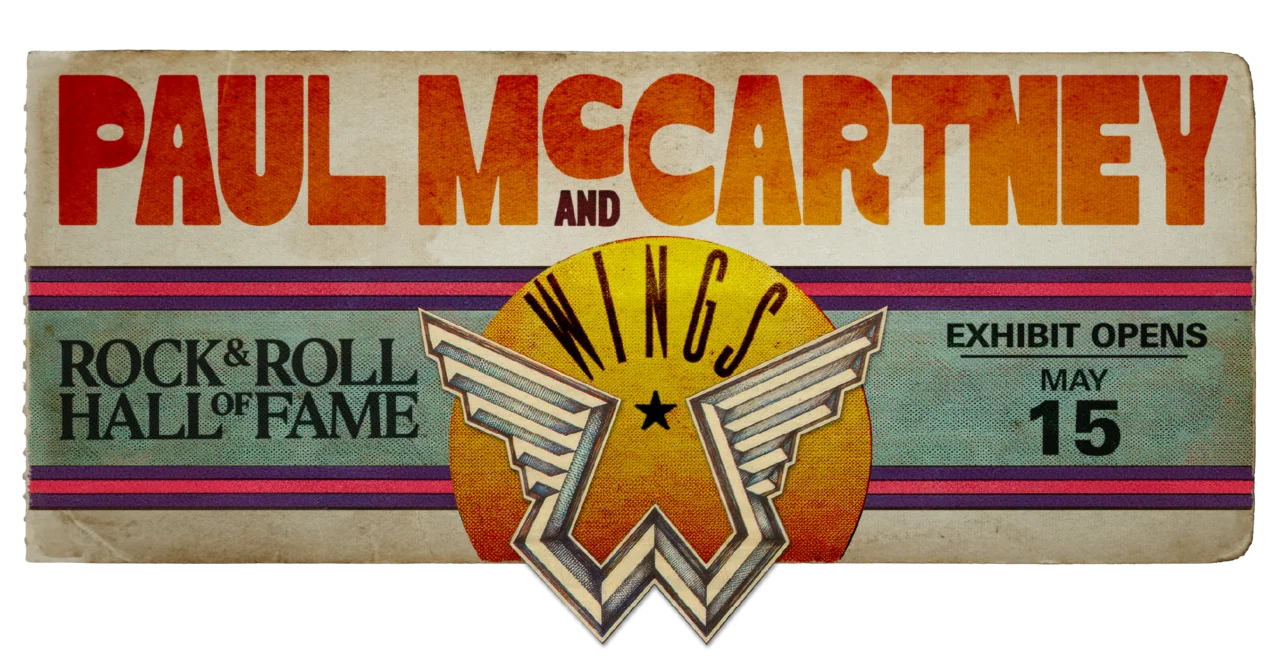
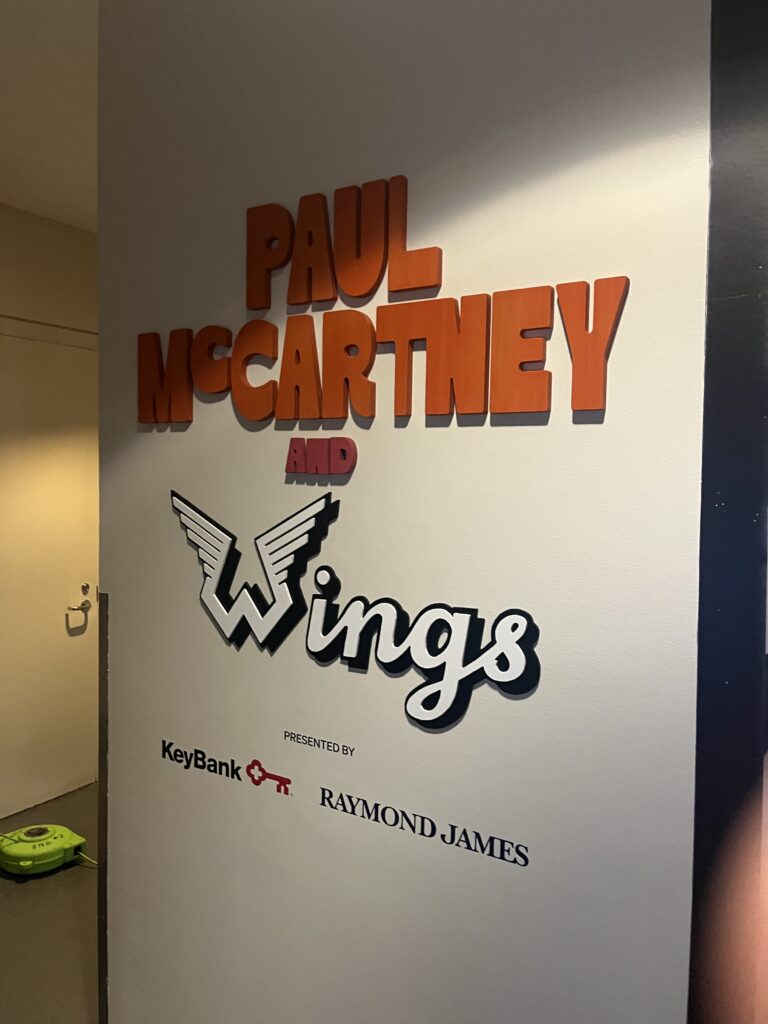
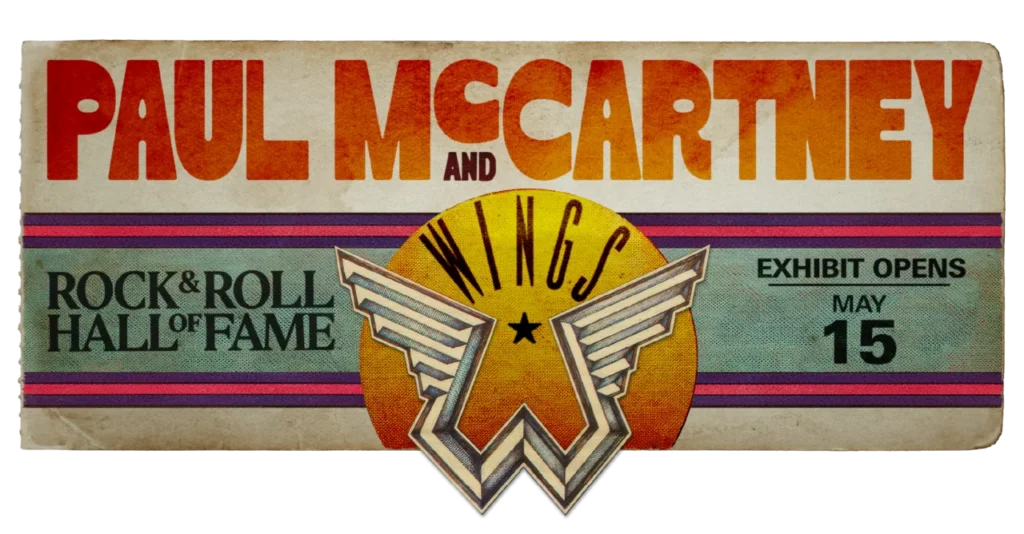
I attended the media preview for “Paul McCartney and Wings,” the Rock Hall’s new special exhibition opening May 15th, and when I asked staff how the long-simmering tensions between McCartney and the institution had finally cooled — and specifically whether the waning influence of Rock Hall co-founder Jann Wenner had anything to do with it — I was met with a response that was either remarkably uninformed or carefully rehearsed: there was never any tension on McCartney’s side, they said.
With respect, that is absurd.
This is well-documented history. When Wenner asked McCartney to induct John Lennon into the Rock Hall as a solo artist in 1994, McCartney agreed — but then raised a reasonable question: what about him? Wenner allegedly promised McCartney his own solo induction the following year. That year came and went. Then another year. Then another. McCartney finally got his solo induction in 1999 — five years after Lennon and four years after the alleged promise. His daughter Stella showed up to the ceremony wearing a white T-shirt that read, simply: *”ABOUT F***ING TIME.”*
In a 2015 interview only recently published by Vanity Fair, McCartney was blunt about what had happened. He felt the institution had been in Wenner’s orbit, which was in Yoko Ono’s orbit, which was squarely in John Lennon’s orbit — at the expense of a fair accounting of McCartney’s own legacy. “A revisionism started to go on,” he said. He didn’t mince words about Wenner either, noting that in all his dealings with him, nothing was ever Jann’s responsibility. “It’s up to these other people down the corridor somewhere.”
So yes — there was tension. It was real, it was documented, and it stretched across years. To say otherwise insults the intelligence of anyone who has followed the history of this institution.
That said — and here’s where the story gets genuinely interesting — something *has* changed. Wenner stepped back from his active role at the Rock Hall, and in the years since, Paul McCartney has quietly reengaged. He inducted Ringo Starr in Cleveland in 2015. He came back to induct the Foo Fighters in 2021. And now, the Rock Hall has devoted its most prominent special exhibit space to him and Wings. The rapprochement is real. It just didn’t happen the way the PR spin would have you believe — as though there was never anything to repair.
The Exhibit Itself: Special Artifacts, Cramped Canvas
Now, to the exhibit.
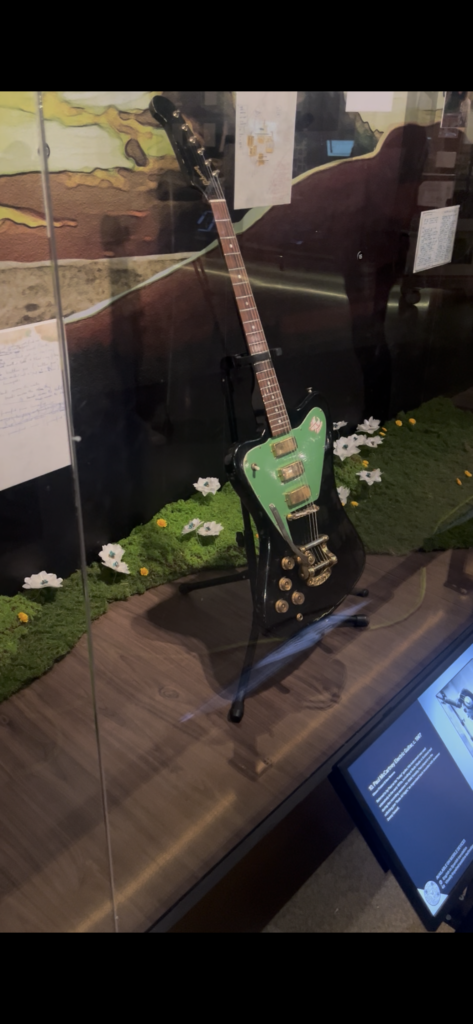
The artifacts are genuinely remarkable. George Martin’s original handwritten orchestral scores for “Live and Let Die” and “Uncle Albert/Admiral Halsey” are treasures. McCartney’s handwritten lyric manuscripts, instruments from Wings’ recording sessions, original album artwork and design proofs, touring wardrobe — this is the real deal, pulled from Paul’s personal archives, and much of it has never been publicly displayed. For any Beatles or McCartney fan, being in the same room as these objects carries weight.
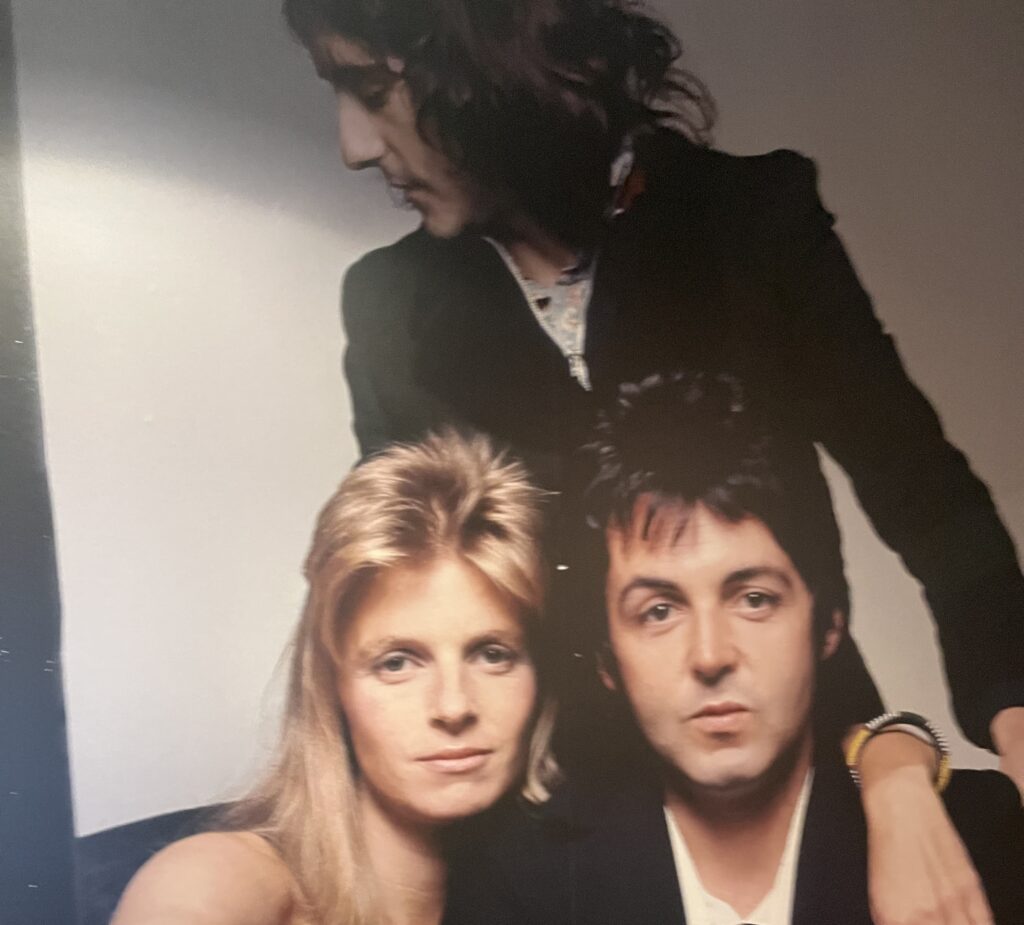
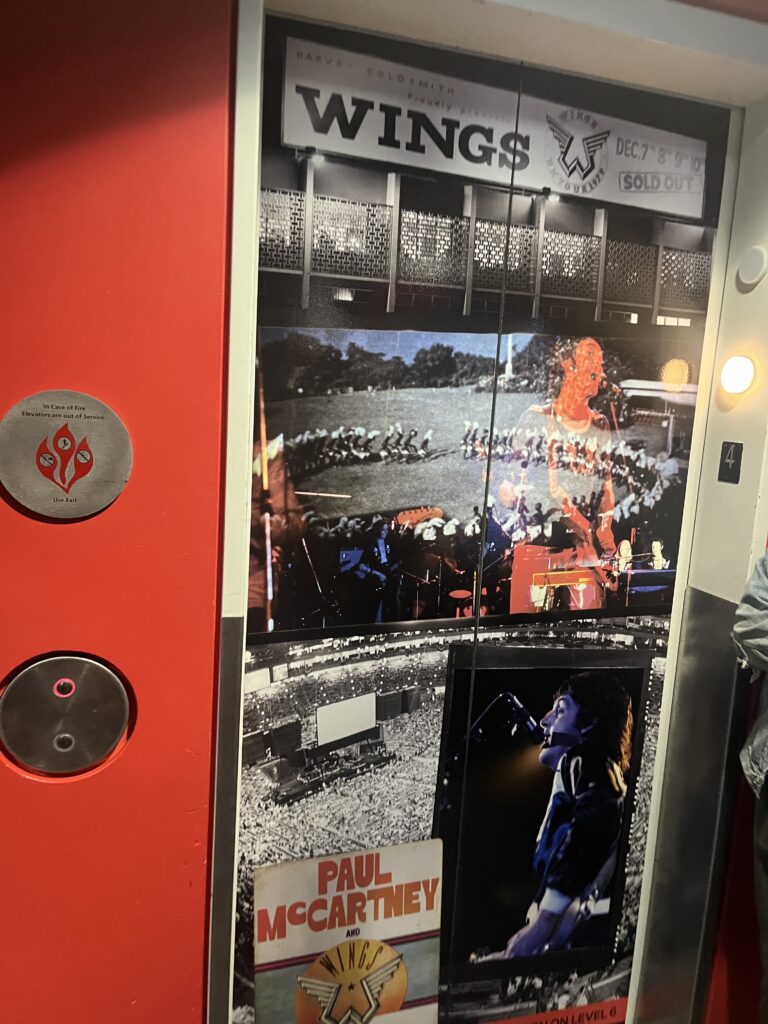
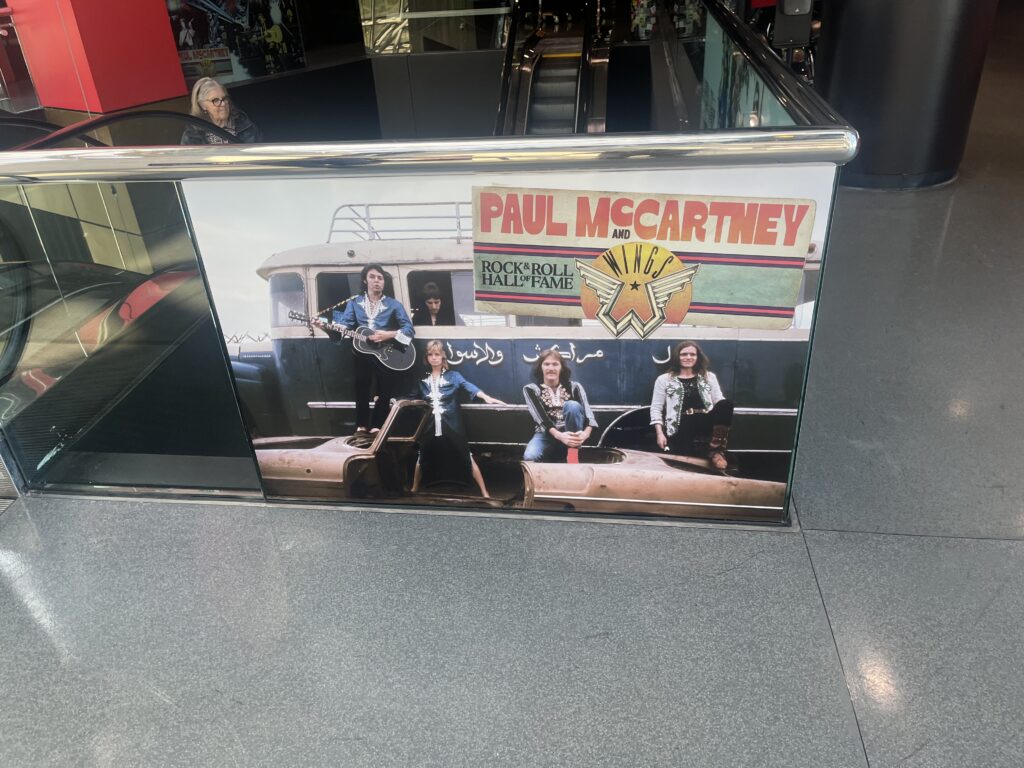
The reconstructed panels from the Wings Over Europe tour bus are a nice immersive touch, and the overall curation does a competent job of telling the Wings decade as a coherent story — from Paul’s tentative solo debut through the scrappy early Wings years, the “Band on the Run” triumph in Lagos, the arena-rock peak, and the eventual dissolution. There’s even a kitchen table setup meant to evoke the domestic, homey McCartney family environment that shaped the band’s unusual dynamic.
But here’s the honest truth: it feels small.
The exhibit occupies the upper-level space that the Rock Hall has traditionally used for special exhibitions. It is a good space. It is not a big enough space for this collection, and the result is an experience that feels slightly cramped — artifacts competing for breathing room in a way that diminishes their individual impact. For a collection of this significance, the physical constraints of the room work against it.
And this is where the comparison to the Lennon exhibit becomes unavoidable.
—
The Lennon Standard: Still the Pinnacle
Nearly 26 years ago, the Rock Hall unveiled *”Lennon: His Life and Work”* — and it was a different animal entirely. That exhibition took over multiple usable spaces within the museum. It was designed by Ralph Appelbaum Associates with Yoko Ono’s direct involvement, evoking the white living room of the Dakota. The white casework, walls, seating, and flooring created a complete environment — you weren’t just looking at Lennon’s things, you were standing in something that felt like his world. It celebrated Lennon as musician, activist, visual artist, husband, and father. It spread across the museum in a way that commanded the building.
It is almost certainly the longest-running and most expansive single-artist special exhibit in Rock Hall history, and it remains the gold standard against which every exhibition here gets measured — fairly or not.
The McCartney exhibit does not reach that bar. The kitchen table is a thoughtful gesture toward the same domestic intimacy that made the Dakota recreation so powerful, but it doesn’t land with the same force. The space simply doesn’t allow it.
This isn’t a knock on the curation — the artifacts are exceptional. It’s a structural limitation, and it matters because this exhibit is arriving at a moment of genuine McCartney cultural rehabilitation. The “Man on the Run” documentary is streaming on Prime Video. The “Wings” oral history book dropped last fall. There was a new compilation album. Paul McCartney is actively, deliberately making the case for his post-Beatles legacy. This exhibit is part of that campaign.
Which brings us to the real question lurking behind all of it.
The Legacy Play: Is Wings Being Lobbied Into the Hall?
Here is what we know: Paul McCartney has been inducted into the Rock Hall twice — as a Beatle in 1988, and as a solo artist in 1999. Wings has never been inducted. The band has been eligible for years. If Wings were to be inducted, McCartney would become only the second person in Rock Hall history to receive three inductions — joining Eric Clapton, who holds that distinction alone.
This exhibit arrives alongside a documentary, a book, a compilation album, and a broader cultural reconsideration of Wings as a legitimate creative force rather than a Beatles footnote. That is not coincidence. That is a campaign.
Is there anything wrong with that? Not necessarily. Wings was a legitimate force. Between 1973 and 1979, they produced five Billboard 200 number-one albums and filled arenas around the world. *Band on the Run* remains one of the great comeback records in rock history. The band’s commercial and cultural footprint during the 1970s is undeniable.
But the orchestrated nature of it all — the simultaneous book, documentary, exhibit, and album — has the texture of a legacy lobbying effort. And it is worth naming that, even as we appreciate the artifacts it has brought to Cleveland.
When I asked the Rock Hall about the cooling of tensions with McCartney, their non-answer was revealing not for what it denied, but for what it suggested: that everyone involved has agreed, tacitly, to move forward. The old grievances are being smoothed over. The institution gets a marquee exhibit. McCartney gets institutional validation for Wings. If a third induction follows, nobody will pretend to be surprised.
Bottom Line
“Paul McCartney and Wings” is a must-see for Beatles fans, McCartney fans, and anyone serious about rock history. The artifacts are extraordinary. The curation is solid. Go see it.
But it is not the definitive exhibit this moment deserved. The space is too small for the ambition of the collection, the institutional context is more complicated than anyone at the Rock Hall will admit to your face, and the shadow of the Lennon exhibit — built in a different era, with different resources, and with Yoko Ono’s full and direct involvement — still looms over everything that happens in this building when it comes to telling the Beatles story.
Paul McCartney has earned his flowers. He’s earning them on his own terms, in his own time, in his own way. That’s very on-brand for the man.
Whether Wings earns a third plaque for him is a question the Rock Hall will have to answer. But this exhibit makes clear that the ask is already being made.
Eugene McCormick is the founder and editor of CLELeader.com. Follow @clevelandleader on YouTube and Twitter/X.